Published

Celebrating locality

Cross-cultural dialogue

No matter if we are able to travel to far-flung places or not – the mixing of cultures, nationalities and heritages happens all around us. It has done so for generations, though today it happens on a larger scale and to a wider demographic. Living in a multicultural world provides us the opportunity to see and understand life on earth from different perspectives, from which we can learn and grow. Globalisation has contributed to a faster and easier transfer of goods and thoughts. We have moved away from locality and diversity to a shared global aesthetic. The modern world stimulates homogeneity globally.

[BRAND NAME] wants to stimulate a more diverse understanding of our modern world by creating clothing that takes locality as inspiration for transforming globalised garments into localised expressions of our multicultural world.

Locally made & sold

Some things can only be found in very specific places in the world. However we have now access to almost anything from anywhere through the convenience of online shopping, international shipping and an interconnected world economy. Almost everything from anywhere is within our reach. The accessibility to such a wide gamma of goods from around the world has made us into greedy and unappreciative consumers. There is value in things being made and sold locally only, as it means the producer and consumer create a stronger connection; in physical contact the meeting of cultures can exist.

[BRAND NAME] wants to stimulate a cultural, personal and emotional exchange between brand, people and product by making certain products only available locally, close to its source of inspiration and/or production.

Published

Pharrell Williams On His Vision for Louis Vuitton

  • It’s okay to dream beyond the realm of possibility.
  • These days so much can be fluffed; authenticity stands out.
  • Luxury is about aspirations (economically free, educated, equal access – freedom).
  • You design for peoples life, for moments in their day – “I want you to feel empowered, to be seen (as a person), to express yourself”.
  • Recognise that you ARE a living human being.
  • Go! Don’t look back, for what? You can see how far you have come later. I’m scarred for when I take my eyes of the sun, I loose my way.

https://podcasts.apple.com/nl/podcast/the-business-of-fashion-podcast/id1225204588?l=en&i=1000631225499

Published

Looking (back) at my own work

Currently my time is been spent on lots of things other than my creative endeavours (of which my personal blog/website is one). My camera has only joined me on the larger trips, my sewing machine and film-scanner have been boxed up and stored away, even my small bag of embroidery tools has been floating around without being used much.
  Life can sometimes get in the way of creativity. When the only time you have for these endeavours is spare time outside of your day-to-day work and lives obligations. This is particularly true when you’re trying to buy a house, build a home and start a family. Sometimes creativity has to be put on the back-burner to progress in life so that your living environment can grow bigger, which in turn will provide you with more space to grow creatively as well. But that’d assume that life admin, settling or a day-job couldn’t or wouldn’t be a creative outlet for me. To some extend this is true, as my hobbies are my most challenging creative pursuits and exercises. On the other hand; my work at de Belastingdienst challenges me in completely new and unfamiliar ways (professionally and creatively) and finding/renovating a home has made me thinking and working more in three-dimensional space.

De Verdieping

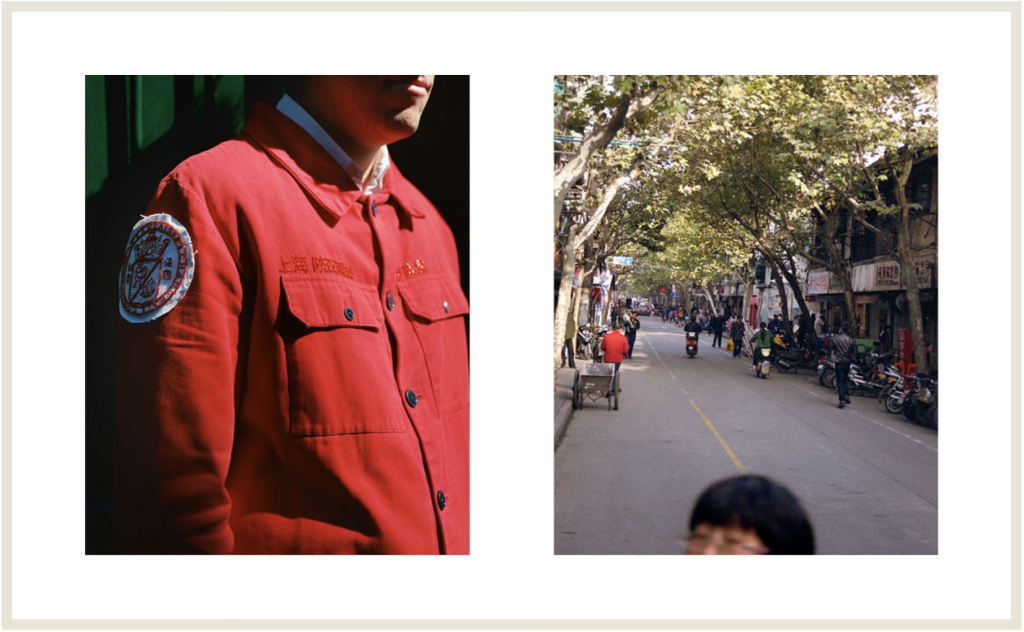
Serendipitously I had been asked to participate in an exhibition right at this time when I was going through a re-start of sorts. De Verdieping is an exhibition by current graphic design students of the University of the Arts Utrecht. They were asked to approach an alumnus of the same course. They would exhibit a work of mine together with a work made in response to that by one of the students (Floor van den Bergh in my case). I have used this opportunity to summarise a certain period in my work/life, accumulated in the Bugao Li jacket. Below is the to be exhibited diptych and accompanying wall description:

After designing the annual 2nd-years graphic design course’s exhibition ‘HQ’ in 2012, I was invited to travel to China. It fascinated me tremendously, to the extent that I returned and eventually would spend most of my graduating year over there. Graphic design is my professional expertise, but in my personal time do I like to work with photography and clothing design. Working with concepts (something my degree has thought me) also comes to the fore in my hobby’s. This work is an accumulation of all these interests; inspired by the history of Shanghai, I made this jacket as if it were that of a gatekeeper in one of the Lilong alleyway estates ‘Cité Bourgogne’ (1930) in the old French Concession.

Published

Observations on trend

Clothing design creates garments that may or may not be trendy.

Trend is based on community, on mass; when a majority considers something of a new/unique (design)style and want to associate themselves with it, you could see a trend appearing of appreciation for this certain style.

When a garment or style is in trend i.e. trendy, you could also say it is in fashion.

A trend being constant would mean it at some point becomes the norm to some extend. When a trend increases for it to degrease at a later stage, you could say it is a fashionable trend. For example; it has come into fashion to be associated with this trend (A), but trend A subsequently becomes surpassed by another trend (B), thus A is not able to sustain itself to become the new norm.

Fashion design therefor is a rather misguided term as it is not the designer that creates fashion, its the people that decide what is in fashion (which in tern is based on trend).

Something can be fashionable when it is designed to go along a certain trend that is currently in fashion. However, it is very unlikely that a designer creates something that will become fashionable, if it is not linked to a current trend within society. The term fashion designer therefor merely means that the designer is designing something that follows a currently fashionable trend (which either can be on the rise or decline, depending on the foresight of the designer). Success as a designer, or the success of their designs, is somewhat dependent on a variety they can bring within the boundaries of a current trend and on the suitability with a currently fashionable trend.
Published

Global vs Local, Fashion vs Clothing

Current trends in fashion seem to be mostly self referential, in the sense that the clothing designs feed off (street)style and archival pieces/references. This creates a strong image that is coherent but refreshing as it’s based on designs and styles that float around in the subconscious minds of the wearer and creator simultaneously (at least amongst those that closely follow/relate to the fashion world). Extending beyond this realm of reference, it has become apart that a wider perspective on art has become a secondary source of inspiration (e.g. music, sculpture, painting).

Although it seems to be aspirational for many to become familiar with these reference points that have instigated pieces of contemporary fashion, it has become less important to know (or show, in the designs) a cultural background and history. Taking Louis Vuitton (Virgil Abloh) and Givenchy (Matthew Williams) as examples here, there is a certain influx of American perspectives within the fashion world (and within traditionally Parisian houses). But also beyond that, when you look at Balenciaga for example, Demna Gvasalia (Georgian) uses inspiration found in Eastern Europe. This however often seems to be a referencing a certain styles, which in turn is often an aspirational versions of an American one.

Thinking about this further

Is it possible to express locality in fashion design? Within the current day and age, in which everything is instantly shareable and readable online, is it even appropriate? Or is that precisely the reason why it would be important to share local identities, exactly because we are so connected and therefor loose a sense of place within the world?

How does expressing locality within fashion design look like? Is clothing design the same as fashion design? Can clothing more effectively represent a local identity than fashion, as fashion suggests a globally shared acceptance of something being “fashionable”?