It has been a long time since I was a ‘local’ in the scanning room at my University (HKU in Utrecht, The Netherlands). They are days to reminisce about as it felt a bit like a club-house for like-minded creatives (including analog photographers). I have sat many hours in the scanning room (until late on Thursdays if I remember correctly) with my best friend Nathan; listening to some music, joking around, while waiting for this slow scanning process to finish. Such is the nature of analog photography these days; although we shoot on film, usually we want to end up with a digital image because – you know… (Instagram?).
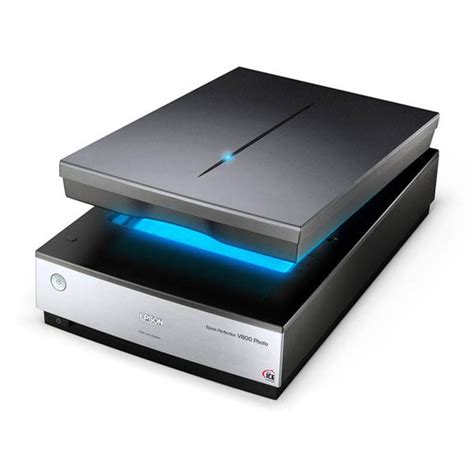
Finally the day has come that I can sit behind this machine again, waiting for those emulsified memories to appear as fresh and clean pixels on my screen. Not at the University this time but at my own desk in my own home. I’m finally a proud owner of an Epson V800. And I have indulged myself by getting SilverFast 8 AI Studio along with it, giving me even sharper scans and better colours. Purchasing it from Scandig (a decent Germany transparency scanner expert) made it feel even more legitimate somehow.
We are still house-bound during the 2020 Covid-19 Lockdown (London, UK). Scanning negatives seems like the perfect quarantine activity you’d almost wish upon anyone who doesn’t know what to do with themselves after prolonged days of boredom. Not that I’m one of those people. I’m so busy with other projects (embroidery, sewing, drawing etc.) that, as a matter of fact, I find the task of scanning my ever expanding archive of negatives slightly daunting. There are currently still about 40 rolls awaiting to be processed and probably more then 60 to be scanned (let alone re-scanning those done on lower-resolution machines in the past while I was waiting for my future purchase).
China has spend much of the last 300 years lurching from one disaster to another. From military crisis to crisis of identity. Yet, perhaps because China’s past is so full of loss and it’s future is so uncertain, many artists seem passionate to preserve their Chinese sense of identity.
Although Andrew’s quote focuses on artists who work in the field of traditional Chinese art (with it’s ancient background which is still highly appreciated as an art-form and practice), it is also applicable to modern Chinese art. Modern Chinese artists often show their culture in a very honest way. Chinese people have a big sense of community and although there might be inequality, anger and things that need changing; they always feel strongly related to their own culture and country.
Chinese art is growing towards a more abstract practice. But still it relates itself to the country’s origins and culture (seen for example in the work of Ai Weiwei and Song Dong). Referencing its own cultural background, you often find in their work comments or a call for change. The culture of China, its origins and its rigidness towards change, are solid like a rock. Its embedded in peoples minds and souls. Moving slowly forward but not forgetting their past. Modern (Chinese) art however, is fluid like water. Wanting to go forward and moving quickly. It makes people nationally and internationally aware of China’s current position and its potential. Perhaps modern Chinese art can wear away (smooth) a rigid rocks and make change happen. At the same time, modern Chinese art comes forth out of its tradition. Its part of the same culture. It doesn’t want to wear off the rock it is made of. It shapes/reshapes itself but stays true to its origin.
Another perspective found in the BBC series, is that on capitalism: Perhaps there exists a thought that China is becoming more western and westernised. But seen in the following quote and connecting that with the previous statement, you could say that neither art nor culture in China are changing. Rather they are developing.
After all, what could be more Chinese than worrying about materialism. Chinese thinkers have been worrying about that for more than 2000 years. And the tiger economy is hardly new [referring to an artwork shown by Xu Bing]. Capitalism is not a Western import, but a Chinese invention. Visit the financial hearth of Shanghai, gaze up at it’s towering monuments to getting and spending, and what do you see? A bold new skyline, yes; but expressing an ancient Chinese impulse to make money. Modern Shanghai is just another version of Emperor Qinzong’s city of Kaifeng, immortalised in the Qingming scroll [referring to the artwork Qingming Shanghe Tu by Zhang Zeduan], where paper money changed hands, back in the 11th century. It’s just another version of Emperors Qianlong’sProsperous Suzhou with its 260 shops.
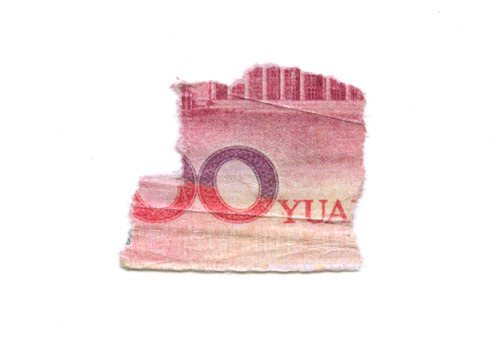
Found teared-up 100 RMB noteon the street in Hunan province
Developing, moving forward with links to its past and staying true to its origin: I have experienced this myself during my time in the country. China is nothing like a western world and not in any way moving towards becoming westernised. China is a country with a very unique culture. I’m interested in understanding more of this and I see the importance of showing it and trying to explain it to others. China does not need to become more western – The west should rather become more understanding of other cultures, including China. By looking at objects of daily life, current culture (its origins and histories) I hope to provide a more complete perspective and understanding of China.
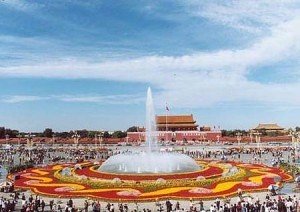
Online found image of Tiananman Square whit the (now removed) central fountain
After two years, I finally found time to start to process my thoughts on China and to further investigate its history, language and culture. Not per se historically, but more so in the present and current culture. How daily life is affected by the past and how this past is seen in the present. Also how the present is represented by different people and in different ways. China has left a big impression on me and made me (very)interested in everything connected and related to it. I feel the need to express my interest – investigate it – and show my views on China, because I think it will help me to understand its culture better. Writing a publication piece-by-piece on this blog will help me to look back on thoughts and re-revise them where necessary (in the final publication).
谢谢, 再见
I have been to China three times within a year’s time (about 8 months in total), this is a list of flights taken to and from China.
30 days 14 November 2012 Amsterdam to Moscow, 13:00 – 19:10 (SU2551) Moscow to Shanghai, 21:10 – 19:45 (SU208) 10 December 2012 Shanghai to Moscow, 01:15 – 07:35 (SU207) Moscow to Amsterdam, 11:20 – 12:00 (SU2250)
30 days 5 April 2013 Brussels to Helsinki, 11.40 – 15:15 (AY2812) Helsinki to Chongqing, 17:30 – 07:10 (AY0055) 3 May 2013 Chongqing to Amsterdam, 08.00 – 18:00 (MU5420)
150 days 13 July 2013 Amsterdam to Zurich, 09:45 – 11:15 (LX725) Zurich to Beijing, 13:20 – 05:15 (LX196) 9 December 2013 Beijing to Zurich, 06:45 – 10:40 (LX197) Zurich to Amsterdam, 12:25 – 14:05 (LX728)